28
Jun
how much benadryl can i give my dog? When your dog is scratching nonstop, breaking out in hives, or reacting to a bee sting, your first instinct is to help fast. Many pet owners reach for a familiar bottle in the medicine cabinet and wonder, “how much benadryl can i give my dog?” It’s a fair question, and you deserve a clear, honest answer. The short version: Benadryl can be safe for dogs in the right dose, but that dose depends on your dog’s weight, health, and the exact product. Before you give anything, the safest move is always a quick call to your veterinarian. This guide walks you through what matters most, so you can act with confidence and care.
Benadryl is the brand name for diphenhydramine, an antihistamine that vets sometimes recommend for mild allergic reactions, itching, and motion sickness. While it’s widely available, “available” doesn’t always mean “safe without guidance.” Your dog’s size, age, and existing medical conditions all change the picture. So before you measure anything out, here’s what you need to understand.
Dosing is never one-size-fits-all. The amount that helps a small terrier could be far too much, and the amount that works for a large breed would do nothing for a tiny dog. That’s why figuring out how much benadryl can i give my dog by weight is the standard starting point most vets use.
But weight is only part of the story. Dogs with heart disease, glaucoma, high blood pressure, an enlarged prostate, or seizures may face serious risks from diphenhydramine. Pregnant or nursing dogs, very young puppies, and senior dogs also need extra caution. This is exactly why no online tool replaces a professional. A search for a “how much benadryl can i give my dog calculator” might give you a rough number, but it can’t see your dog’s full medical history the way your vet can.
Here’s a warning that can save your dog’s life. Many “Benadryl” and allergy products contain more than plain diphenhydramine. Some include decongestants like pseudoephedrine or phenylephrine, which are toxic to dogs. Others, especially liquid or chewable versions, contain xylitol, an artificial sweetener that can be deadly even in small amounts.
Before giving anything, read the active ingredient list. If it says anything other than diphenhydramine alone, do not give it without your vet’s approval. When in doubt, snap a photo of the label and ask.
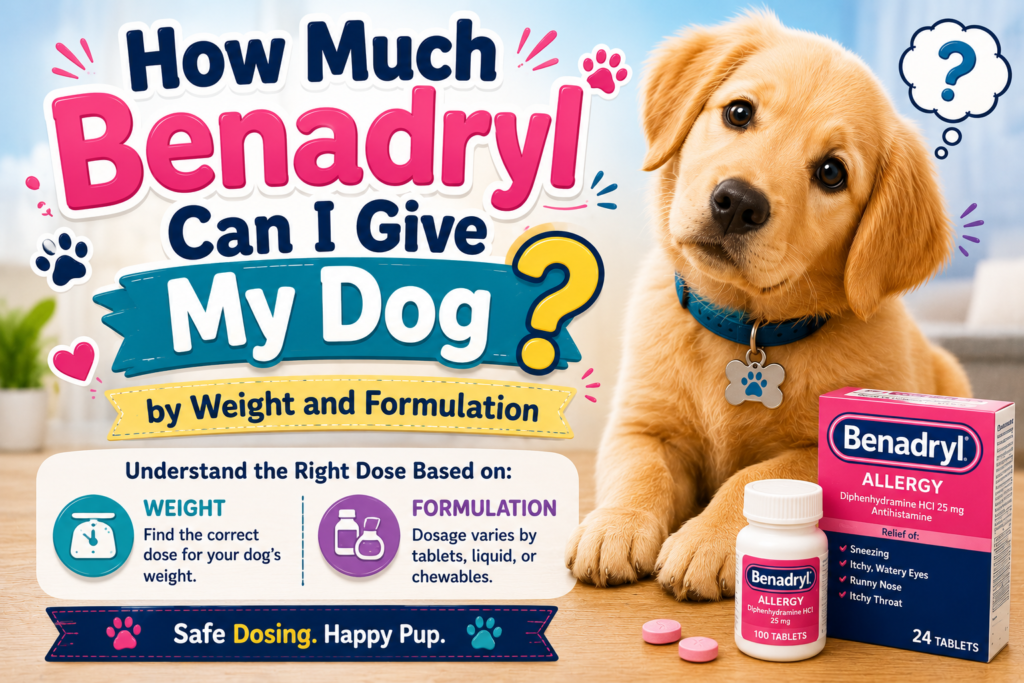
Now to the heart of your question. The commonly cited veterinary guideline is roughly 1 mg of diphenhydramine per pound of body weight, given up to two to three times a day. Still, “commonly cited” is not the same as “right for your dog today.” Always confirm with your vet before you give a single dose. Think of the figures below as context, not a prescription.
The form you use matters because concentrations differ widely.
If you’re unsure how much liquid benadryl can i give my dog, this is one area where a vet’s input is essential. Liquids carry the highest risk of accidental overdose.
People search for very specific numbers, and it helps to see how weight changes the conversation. The examples below illustrate the general “1 mg per pound” framework, but treat them as discussion points to bring to your vet, not exact instructions.
Owners frequently wonder how much benadryl can i give my 10 lb dog or how much benadryl can i give my 15 pound dog. For small dogs, precision is critical because the margin for error is tiny. Whether your question is how much benadryl can i give my 20 lb dog or something smaller, even a slight miscalculation can cause problems. This size range is where children’s formulas tempt owners most, so the xylitol warning matters even more here.
A common search is how much benadryl can i give my 30 lb dog, often when a medium dog reacts to an insect bite or seasonal allergen. Questions like how much benadryl can i give my 50lb dog and how much benadryl can i give my 50 pound dog come up constantly, because this is one of the most common dog sizes. Tablets are usually easier to dose accurately than liquids in this range.
For bigger breeds, owners ask how much benadryl can i give my 60 lb dog or how much benadryl can i give my 70 lb dog. You’ll also see how much benadryl can i give my 70 pound dog and how much benadryl can i give my 80 lb dog phrased slightly differently but meaning the same thing. With giant breeds, how much benadryl can i give my 100 lb dog requires careful confirmation, because larger totals still need a vet’s sign-off to be safe.
A “how much benadryl can i give my dog chart” can be a helpful starting reference, and so can a calculator tool. But these are estimates built on averages. They don’t know your dog has a heart murmur or takes another medication. Use them to prepare questions for your vet, not to replace the vet’s judgment.
A frequent reason owners reach for this medication is seasonal or environmental allergies. If you’re asking how much benadryl can i give my dog for allergies, know that diphenhydramine can ease mild itching, sneezing, and minor reactions. However, ongoing allergies often need a proper diagnosis. Repeated dosing without a plan can mask a problem that deserves real treatment. So whether your concern is one flare-up or a chronic itch, and whether you’re asking how much benadryl can i give to my dog once or daily, loop in your vet for a lasting solution.

Even at safe doses, your dog may show:
These usually fade on their own. Still, note anything unusual and mention it to your vet. Be careful about your dog’s diet because it directly related to dog health problems.
Call your vet or an emergency animal hospital right away if you notice:
These signs can point to an overdose, a severe allergic reaction, or toxicity from a hidden ingredient. Don’t wait it out. Fast action saves lives. keep noticing what your dog ate before administering the medication.
If you remember one thing from this guide, let it be this: a worried owner deserves quick guidance, but quick should never mean reckless. Benadryl can genuinely help dogs with mild allergic reactions, but the safe dose depends on weight, health history, and the exact product in your hand.
So here’s your simple checklist for today. First, read the label and confirm the only active ingredient is diphenhydramine, with no decongestants or xylitol. Second, write down your dog’s current weight and any health conditions or medications. Third, call your veterinarian or an after-hours animal clinic and confirm the dose before giving anything. Finally, watch closely for side effects and act fast on any red flags.
You clearly love your dog, or you wouldn’t be doing this homework. That instinct to protect them is exactly right. Use it by making that one quick call. Your vet can turn your worry into a clear, safe plan in just a few minutes.