17
Aug
Quick answer: How many teeth do cats have? Adult cats have 30 permanent teeth, while kittens start with 26 deciduous (baby) teeth. Cats develop two sets of teeth across their lifetime, each designed to support their natural carnivorous diet. Understanding feline dental anatomy can help you spot problems early and keep your cat healthier for longer.
Cats are extraordinary creatures—built to hunt, stalk, and survive. Every whisker, claw, and tooth serves a precise biological purpose. Yet feline dental health is one of the most overlooked aspects of cat care, with the American Veterinary Dental Society estimating that over 70% of cats show signs of oral disease by age three. Whether you’re a first-time cat owner or a seasoned feline enthusiast, knowing what’s happening inside your cat’s mouth is the first step toward keeping them comfortable and healthy.
This guide breaks down everything you need to know: from the number of teeth cats are born with, to the types of teeth in a fully grown cat’s mouth, to practical tips for keeping those teeth in top shape. By the end, you’ll have a clear picture of your cat’s dental anatomy—and the tools to act on it.
Like humans, cats are diphyodonts—meaning they develop two sets of teeth over their lifetime. The first set, known as deciduous or baby teeth, emerges during kittenhood. These are eventually replaced by a permanent adult set as the cat matures.
Knowing how many sets of teeth do cats have is more than a fun fact. It directly informs how you monitor your kitten’s health and development, when to schedule dental checkups, and how to spot early signs of tooth abnormalities. Retained baby teeth, for instance, can occur when a permanent tooth erupts before the baby tooth falls out—a condition that may require veterinary intervention.
Kittens are born toothless. Their first teeth begin to emerge around two to three weeks of age. So, how many baby teeth do cats have in total? Kittens develop 26 deciduous teeth—also called milk teeth or primary teeth.
Here’s how those 26 teeth are distributed:
Notice that kittens have no molars at all. Molars only appear with the adult set. By around six weeks of age, most kittens have their full set of 26 baby teeth. The transition to adult teeth typically begins around 11 to 16 weeks and is usually complete by six to seven months of age.
Once the deciduous teeth fall out, the permanent set takes over. How many adult teeth do cats have? A fully grown cat has 30 permanent teeth. This is the number that applies to all healthy domestic cats, regardless of breed.
The adult set breaks down as follows:
How many teeth do adult cats have compared to other common pets? For context, adult dogs have 42 permanent teeth, and adult humans have 32 (including wisdom teeth). Cats fall on the lower end of that range—but every single one of their 30 teeth is purposefully designed.
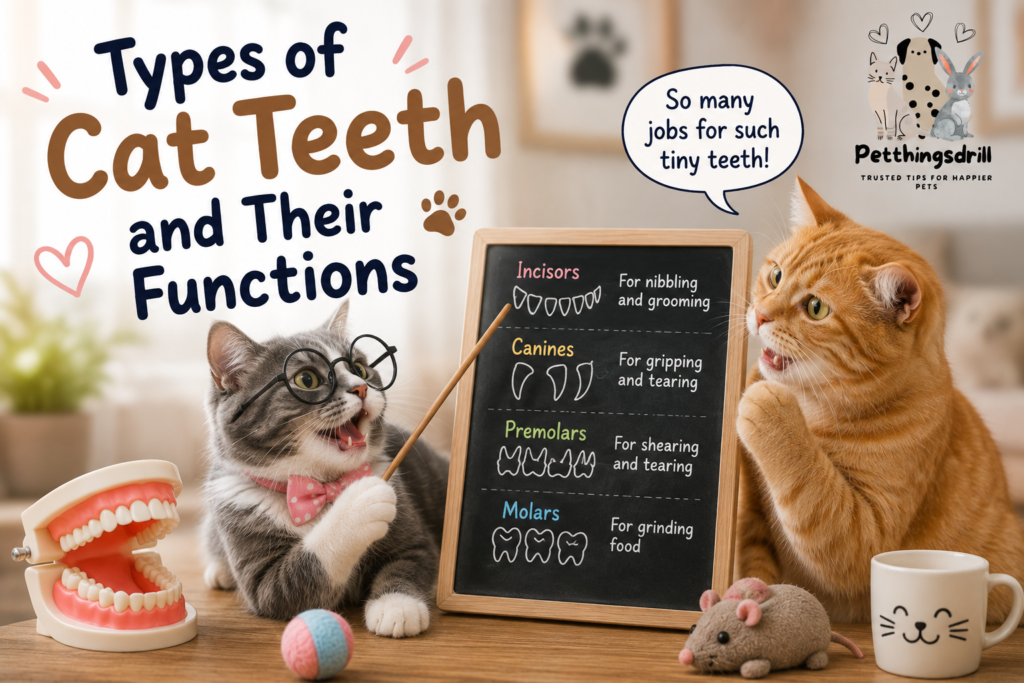
Understanding what each tooth does reveals just how precisely a cat’s mouth is engineered for its role as a predator.
Cats have 12 incisors—small, flat teeth located at the very front of the mouth. These are the teeth you’ll notice when a cat opens its mouth wide. Incisors are used for grooming, nibbling at small pieces of food, and scraping meat from bones. They’re the least forceful teeth in the cat’s arsenal but among the most versatile.
The four canine teeth are the long, curved, pointed fangs flanking the incisors—two on top, two on the bottom. These are arguably the most iconic teeth in a cat’s mouth. Canines are designed for gripping and killing prey, delivering a precise bite between the vertebrae of small animals. In domestic cats, they’re also the teeth most likely to cause injury during play biting.
Cats have 10 premolars in their adult set. These teeth sit behind the canines and have a jagged, blade-like shape. Their primary function is shearing—slicing through meat and tough connective tissue with a scissor-like action. The carnassial teeth, which are the largest premolars (the upper fourth premolar and lower first molar), are particularly powerful and are responsible for most of a cat’s chewing force.
Adult cats have four molars—two in the upper jaw and two in the lower jaw. Molars are the last teeth to develop and sit at the very back of the mouth. In cats, molars are relatively small and less prominent than in omnivores or herbivores, because cats don’t grind plant matter. Their molars primarily assist with crushing and processing food before swallowing.
There’s often confusion about whether different types of cats have different numbers of teeth. The answer is straightforward: how many teeth do house cats have is the same as any other domestic cat. Whether you have a sleek Siamese, a fluffy Maine Coon, or a scrappy mixed-breed rescue, how many teeth do domestic cats have remains constant at 30 adult teeth.
Breed differences may affect the size, shape, or spacing of teeth—brachycephalic breeds like Persians, for instance, may experience more crowding due to their flattened facial structure—but the total count stays the same across the species.
If you’ve ever peered inside your cat’s mouth and wondered how many teeth do cats have in their mouth at any given moment, the answer depends on age. Kittens in transition (between 11 weeks and 7 months) may have a mix of baby and adult teeth simultaneously as the permanent set pushes through.
Knowing how many teeth do a cat have is only useful if you also understand how to protect them. Dental disease is one of the most common—and preventable—health issues in domestic cats. Here’s what every cat owner should know.
Brush regularly. Daily tooth brushing with a cat-specific toothbrush and enzymatic toothpaste is the gold standard for at-home dental care. Start young, go slowly, and use positive reinforcement.
Schedule professional cleanings. Veterinary dental cleanings under anesthesia allow for a thorough examination, scaling, and polishing—reaching areas no toothbrush can. Most vets recommend annual cleanings for adult cats.
Use dental treats and toys. Chewing on appropriate dental toys and treats can help reduce tartar buildup mechanically. Look for products approved by the Veterinary Oral Health Council (VOHC).
Watch for warning signs. Bad breath, drooling, pawing at the mouth, changes in eating habits, or visible tartar buildup can all indicate dental problems. Early intervention is far less invasive—and less costly—than treating advanced disease.
Don’t ignore tooth resorption. Feline tooth resorption is a painful condition where the tooth structure breaks down from the inside out. It affects an estimated 20–75% of adult cats (according to Cornell Feline Health Center) and can be difficult to detect without dental X-rays—another reason annual vet checkups matter.
How many teeth do cats have in their mouth as adults?
Adult cats have 30 teeth in total: 12 incisors, 4 canines, 10 premolars, and 4 molars. All 30 are permanent teeth that replace the 26 baby teeth kittens are born with.
At what age do kittens lose their baby teeth?
Kittens begin losing their baby teeth around 11 to 16 weeks of age. Most cats have their full set of 30 permanent adult teeth by six to seven months old.
Can cats live normally with missing teeth?
Yes—cats can adapt well to missing teeth, especially if the teeth were lost gradually or removed by a vet due to disease. Cats with missing teeth may need softer food, but most continue to eat, groom, and play without significant difficulty.
What does it mean if my cat’s teeth are yellow or brown?
Discoloration usually signals tartar buildup, which is a precursor to periodontal disease. Yellow or brown teeth warrant a veterinary dental exam. Left untreated, tartar can lead to gingivitis, tooth loss, and systemic infections.
Is it normal for cats to lose teeth as adults?
Adult tooth loss is not normal and typically indicates dental disease, injury, or a condition like tooth resorption. If you notice a loose or missing tooth in your adult cat, consult a veterinarian promptly.
How do I know if my kitten is teething?
Teething kittens may chew on objects more frequently, eat more slowly, or show mild irritability. You may find tiny baby teeth around the house—though kittens often swallow them harmlessly. If your kitten seems to be in significant pain, a vet visit is worthwhile.
Do cat breeds with flat faces have dental problems?
Yes. Brachycephalic breeds like Persians and Exotic Shorthairs are prone to dental crowding and misalignment because their teeth must fit into a shorter jaw. This increases the risk of tartar buildup and periodontal disease, making regular dental checkups especially important for these breeds.
Thirty teeth stand between your cat and a lifetime of discomfort. That may not sound like many—but each one plays a role in how your cat eats, grooms, and interacts with the world. Dental neglect doesn’t just cause bad breath; it can lead to chronic pain, organ stress from oral bacteria entering the bloodstream, and a significantly reduced quality of life.
The good news? Prevention is straightforward. A consistent at-home brushing routine, annual professional cleanings, and regular observation of your cat’s mouth can make an enormous difference. Start by scheduling a dental exam with your vet if you haven’t already—your cat’s teeth will thank you for it.